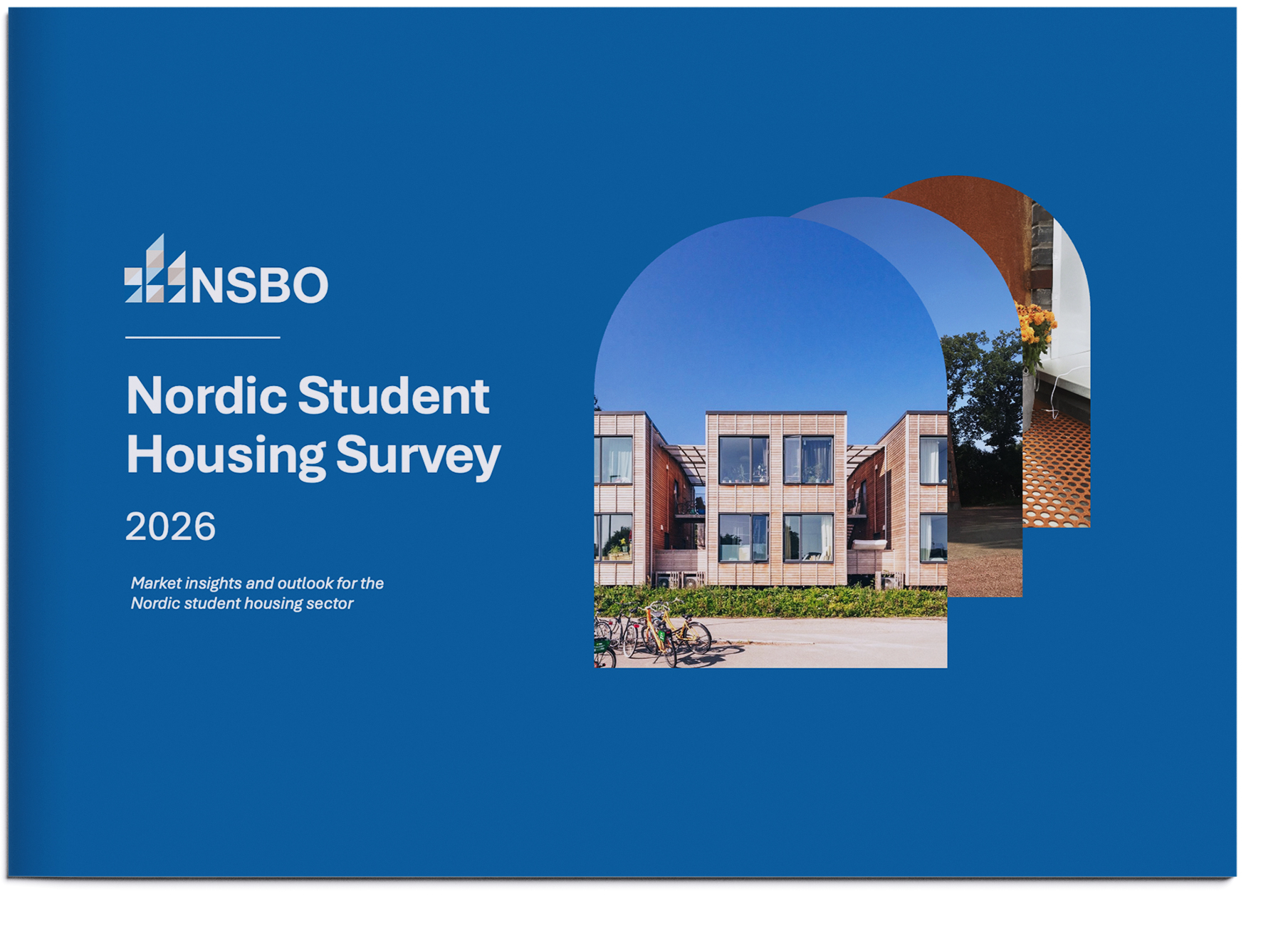
New report: A nordic outlook on student housing
26 sep 2026CEOs from across the Nordic region share their views on the challenges and opportunities facing student housing today and in the years ahead. Discover which factors are shaping the sector most, and how industry leaders view new construction, AI and current market conditions.
The results show that the overall view of the national student housing markets remains relatively positive across the Nordic countries. On a five-point scale (where 5 indicates a very positive outlook), the Nordic average stands at 3.9.
At the same time, confidence in the future of respondents’ own organisations is consistently higher, with a Nordic average of 4.2. In all countries except Norway, respondents express the same or greater confidence in their own organisation than in the national market.
The gap between perceptions of the market and one’s own organisation may indicate that actors see some uncertainty in the external environment while maintaining relatively high confidence in their own ability to adapt to changing conditions.
How positive are you about the future of…
Economic factors seen as having the greatest impact
The results show that economic factors are perceived as highly influential in shaping the student housing market. In particular, respondents highlight construction and renovation costs, students’ financial situation and growing demand for affordable rents.
Policy and regulation continue to play an important role in setting the framework for the sector, but economic conditions are increasingly seen as the key drivers affecting market development and organisational priorities.
Construction and investment under changing conditions
Many organisations state that they remain willing to invest in both new developments and upgrades of existing housing stock. At the same time, few expect conditions for carrying out projects to improve in the coming years. High construction costs and financing conditions are highlighted as key factors affecting project feasibility.
Digitalisation established – AI still at an early stage
Digital solutions are now seen as an established part of operations among many actors in the sector. At the same time, the results show that the use of AI and automation remains at an earlier stage in many organisations.
As both cost levels and demands for efficiency continue to increase, the findings suggest that digitalisation and AI may become increasingly important in the years ahead, particularly in areas such as analytics, operations and customer relations.
A sector adapting to change
Overall, the report presents a picture of a sector that is fundamentally stable, but increasingly shaped by changing conditions. Economic factors, shifts in demand and policy developments interact in different ways across the Nordic countries.
At the same time, organisations express relatively strong confidence in their own ability to adapt to these changes. This points to a sector that is gradually evolving in response to new demands and opportunities.